Rainwater goods
Guttering in Stafford
Guttering exists to collect what the tiles shed and pass it to a downpipe. When it stops doing that, the place where water escapes is your best clue.
Quick view
- A blockage and a bad fall can look alike from below
- Check the fascia whenever a gutter sags
- Roof water needs a suitable place to discharge
- Diagnose from the ground, not from a wobbling ladder
Match the symptom
| Where you see water | What might be behind it | What to ask for |
|---|---|---|
| Spilling over along a stretch | Debris holding it back, a gutter that no longer slopes to its outlet, or one too small for the roof above | Clearing first, then a test with water to see how it runs |
| Dripping at one join | A perished seal, a clip that has let go or a split fitting | Whether that single piece can be renewed |
| Standing in a low spot | Brackets that are loose, far apart or screwed into soft wood | A look at the board behind before new brackets go in |
| Running down behind the gutter | Water missing the trough at the roof edge, for instance where the underlay has failed | An opinion on the roof edge as well as the gutter |
| Backing up out of a downpipe | Something lodged in the pipe, the shoe or the drain below | The whole route cleared down to the drain |
Trees, moss and tile grit
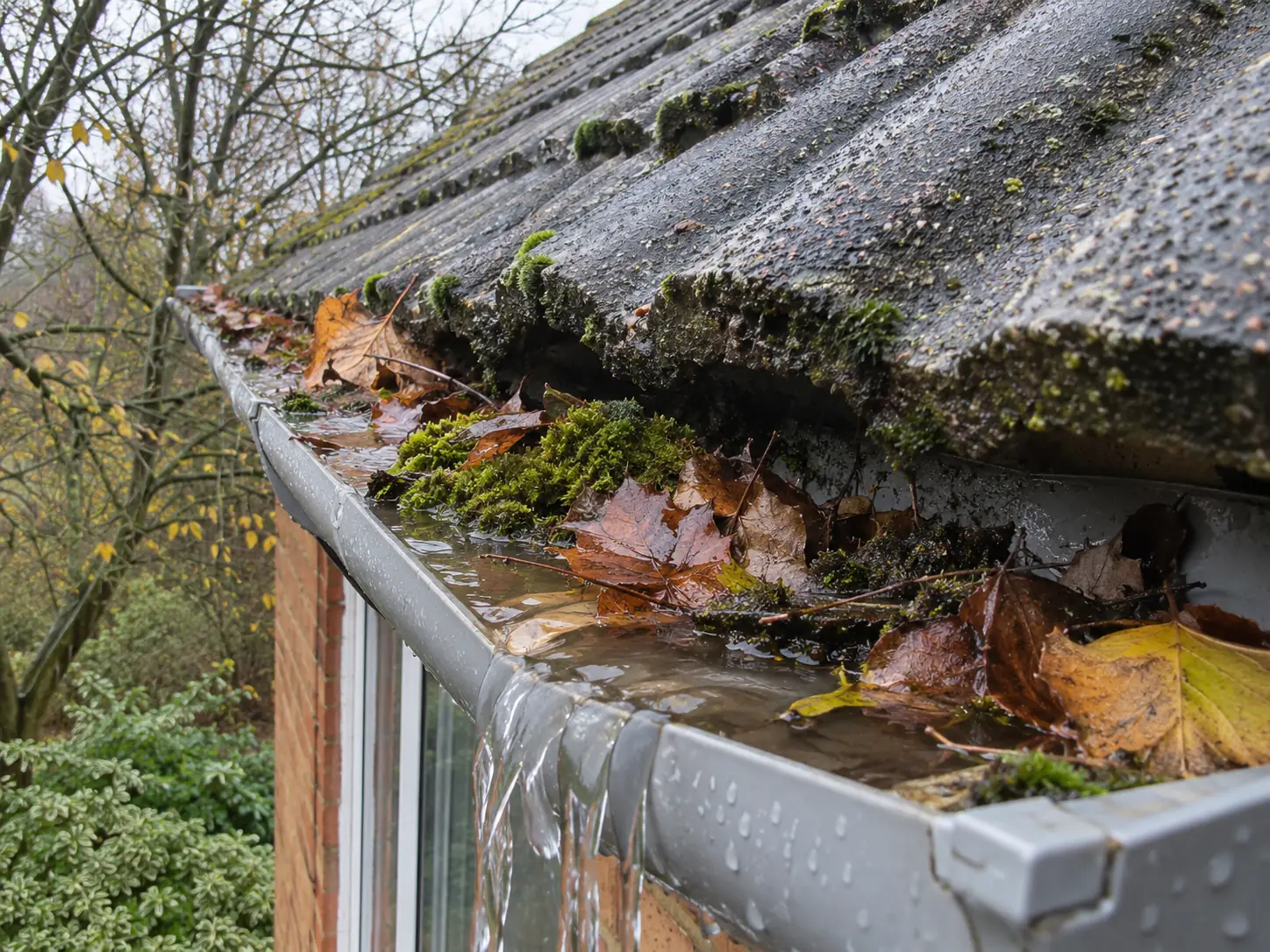
Houses beneath or beside trees collect leaves, seed cases and twigs. Concrete tiles can add moss and grit, which settle in the bottom of the gutter and give the next lot of leaves something to cling to. A clear-out after leaf fall is a simple habit. If a guard is suggested, ask how it is lifted or cleaned once debris builds up on top.
Where the rain should finish up
Building regulations state the basic duty in one sentence.
Adequate provision shall be made for rainwater to be carried from the roof of the building.
legislation.gov.uk: Building Regulations 2010, Schedule 1, H3
Requirement H3 goes on to rank the outlets. Soaking into the ground comes top, for instance through a soakaway; a stream or ditch is next and a sewer last, each step down being allowed only if the better option is not reasonably practicable. The linked text has the exact terms. If a quote involves moving a downpipe or sending water somewhere different, ask building control or the installer to confirm the arrangement. A pipe ending on the paving beside the wall is worth pointing out.
Mend it or start again
A single failed union on an otherwise firm run is a reasonable thing to repair, if a matching part can be had. Estate houses fitted decades ago may have a profile that is no longer easy to match, so ask. Where several joints weep, the line wanders and the board behind is soft, patching tends to chase one fault after another.
Old cast iron needs a separate thought. In the Stafford Borough areas with an Article 4 Direction, the council’s list of work likely to need permission includes this line.
The replacement of cast iron guttering with plastic, or the addition of new guttering and downpipes;
Stafford Borough Council: Conservation Areas
That list belongs to particular areas, not to every house in Stafford. Check where yours stands on the older homes page. If the boards are failing too, one visit for both avoids brackets coming off twice; the replacement guide covers the combined job.
What to record before you ask
Next time it rains hard, watch from a window or stand somewhere safe on the ground. Take a short video of the spill or drip. Then step back for a wide picture of that elevation, which shows the height, any conservatory or garage roof below and the room there is for a ladder or tower. Note whether the trouble appears in every shower or only in downpours.
If a length has come loose above a door, path or drive, keep people and cars clear and get local help promptly. Leave the climbing to someone equipped for it.
Describe where the water goes and when; that is plenty to begin with.
Start a Stafford quoteGutter not coping?
Say which wall it is on and what happens in heavy rain.